Published - 9th Sep 2026
A rotating component must be balanced before it goes into service. However precise the casting and machining, slight inconsistencies in the distribution of mass across the component can cause issues with vibration at high revolutions – dynamic balancing removes these inconsistencies.
Haworth Castings has invested in a dedicated dynamic balancing cell. Now, we can take a component from pattern to finished, balanced assembly under one roof, accountable for the result at every stage.
Customers benefit from working with a single supplier across casting, machining, balancing and overspeed testing: saving time, simplifying the supply chain, and providing a single point of accountability for the finished, verified component.
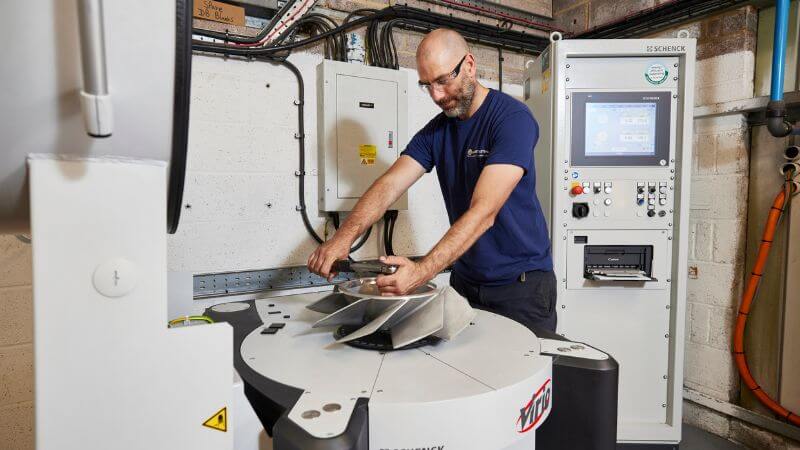
Dynamic balancing is the process of correcting any uneven weight distribution in a rotating component. Even small irregularities in mass distribution generate centrifugal forces that scale with the square of rotational speed. A minor imbalance that appears manageable at low speed can become destructive at operating RPM. Left unaddressed, imbalance is a leading cause of bearing damage, premature wear and reduced service life in rotating components. It can produce unnecessary noise, lead to inefficient fuel consumption, and in safety-critical applications can ultimately lead to failure.
Haworth Castings has installed a Schenck Virio 50/1, a market-leading vertical hard-bearing balancing machine. The Virio range is used globally for precision balancing of shaft-free rotating components, including impellers, pump rotors, flywheels and turbine components up to 50kg and with a diameter of up to 810mm. The machine uses permanent calibration and digital signal processing to identify the precise location and magnitude of imbalance, guiding our balancing team to remove the exact material needed to bring the component within tolerance.
Balancing is a skilled, iterative process. Once the machine identifies the imbalance, our balancing team remove the component, manually trim material and retest, repeating until the required balance grade is achieved. Trimming material to achieve the required balance grade calls for experienced judgement, and Haworth Castings has invested in the right team to deliver it: our new balancing cell is managed by a specialist with significant balancing experience, supported by a trained balancer and dedicated quality control function.
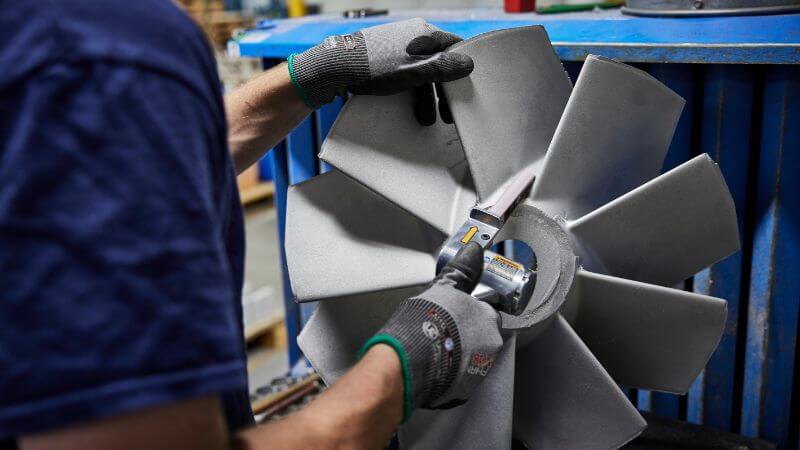
Haworth Castings has produced aluminium sand castings for a long-standing defence customer for many years, supplying impellers for cooling systems used in military fighting vehicles. Demand for high-performance thermal management in armoured and fighting vehicles is significant and growing, and the components Haworth Castings supplies are central to that capability.
Our customer has extensive balancing capabilities in-house, but increasing demand for their cooling systems led them to ask Haworth Castings to take on the balancing, testing and finishing of certain high volume fan assemblies. By relocating our fettling facility, we have been able to install a new dynamic balancing cell to provide this capability.
Designing a safe overspeed test rig
Haworth Castings also collaborated with this customer to design an overspeed rig for their assembled components. Overspeed rigs are used to stress-test assembled components by spinning them beyond their maximum operating speed to verify structural integrity before delivery. The overspeed test rigs designed by Haworth Castings for the customer incorporate numerous safety features, including a containment enclosure, vibration detection and interlock safety systems. One unit is now in use at the customer’s facility; the other is retained at Haworth Castings for production use.
Understanding customers’ engineering challenges
Haworth Castings’ new balancing cell combines the Schenk dynamic balancing machine with the overspeed test rig, forming a self-contained facility for balancing and overspeed testing. Haworth Castings now produces three impeller variants for this customer, ranging from 305mm to 470mm in diameter; carries out sub-assembly; balances the completed assemblies; performs overspeed testing; and delivers finished products ready for integration into the cooling systems.
For procurement teams and engineers, a single supplier accountable for the complete production sequence brings real, practical benefits. From casting and machining through to balanced assembly, there are fewer handoffs, faster resolution of any issues, and complete traceability from raw material to finished component.
The sequence does not stop at balancing: Haworth Castings can also carry out the inspection and finishing steps that follow, such as crack detection, dye penetrant testing and surface treatment such as painting: customers can receive a component ready for final integration. For supply chains serving defence, aerospace and marine customers, that integrated manufacturing partnership has tangible commercial and operational value.
Haworth Castings also has capacity on the Schenck Virio 50 cell to offer dynamic balancing as a standalone subcontract service. If your production process involves rotating components that require precision balancing, our team can handle shaft-free components up to 50kg, with the precision, traceability and quality documentation expected in regulated and safety-critical industries.
The balancing cell is suitable for testing a range of shaft-free rotating components for sectors including EV, marine, aerospace and defence. Current and target applications include:
Whether you need a fully integrated casting, machining and balancing solution, or standalone balancing services for components you already produce, Haworth Castings has the team to help. Contact us to discuss your requirement, or find out more about our precision casting for defence manufacturing.
Author: Luke Moran is Sales and Marketing Director at Expromet Technologies Group, working closely with Haworth Castings and its sister companies to develop new capabilities and customer partnerships across the group.
What is dynamic balancing used for?
Dynamic balancing corrects uneven weight distribution in rotating components while they are in motion. It is used to reduce vibration, prevent premature bearing and seal wear, and ensure safe, efficient operation in equipment such as pumps, turbochargers, motors and propulsion systems.
What is the difference between static and dynamic balancing?
Static balancing corrects imbalance in a stationary component, while dynamic balancing corrects imbalance while the component is rotating at speed. Dynamic balancing is required for components with significant axial length or those operating at high rotational speeds.
Does Haworth Castings offer balancing for components it did not manufacture?
Yes. Haworth Castings offers dynamic balancing as a standalone service for shaft-free rotating components up to 50kg and 810mm diameter, regardless of where the component was cast or machined.
What applications does Haworth Castings’ balancing service support?
Applications include pump impellers, turbocharger impellers, electric motor rotors, marine propulsion components such as waterjet impellers and thruster rotors, flywheels, and air turbine blisks.
If you have a project, talk to our experienced sales team
Contact usAccess our library of aluminium sand casting photographs, video animations and articles.