Published - 30th Mar 2026
Advances in metallurgy and casting techniques have made it possible to produce metal components that are lighter, stronger and more geometrically complex than ever before. These parts are often expected to perform for long periods in demanding environments, where even small variations in material integrity, internal soundness or dimensional accuracy can affect fatigue life, corrosion resistance or structural performance.
For buyers looking at how to choose a metal castings supplier to source sand cast or gravity die cast components, the key question is not simply whether a casting meets specification at the point of delivery. It is whether the supplier’s processes can deliver durable, reliable performance consistently over time. That is where quality control in metal castings becomes critical.
Technical oversight and quality leadership
This article reflects the practical quality control approach applied across Haworth Castings and the wider Expromet Technologies Group, informed by group-level technical and quality leadership across sand casting, gravity die casting and downstream manufacturing. Group Technical and Quality Director Keir Lane notes that in performance-critical casting programmes, quality control is fundamentally about reducing risk.
“As components become more complex and applications more demanding, the tolerance for variation disappears. Our responsibility is to ensure quality is designed and controlled from the outset, not managed after problems appear.”
Quality control in metal castings is often assumed to mean final inspection and certification. In practice, it is much broader. Effective quality control combines design decisions, process control and verification activities to reduce variation and protect performance throughout production.
At its core, quality control is about consistency. Buyers need confidence that a supplier can produce castings that meet specification reliably, batch after batch. That consistency depends on quality being built into the programme from the earliest design discussions through to inspection and continuous improvement.
a) Designing quality in from the start
Quality control begins at the design stage. Design for Manufacture (DFM) is one of the most important quality tools because early design decisions strongly influence how a casting behaves during manufacture and in service.
Wall thickness, section transitions, fillet radii and tolerance selection all affect metal flow, solidification behaviour and residual stress. When these factors are considered alongside the chosen casting process, potential risks can be addressed before production begins. When combined with casting simulation, DfM helps reduce defect risk, minimise unnecessary machining and support more consistent long-term performance.
“Design for Manufacture is one of the most powerful quality control tools we have,” says Keir. “When casting behaviour, material performance and service conditions are considered at the design stage, many downstream quality risks simply never arise.”
b) Process control through manufacture
Beyond design, quality control depends on disciplined process control during manufacture. In metal casting, that includes control of raw material quality, melt chemistry, temperature, mould or tooling condition, pouring practice and cooling behaviour. Each of these variables influences internal soundness, mechanical properties and service life.
A robust process does not rely on inspection to catch variation after the event. It aims to prevent variation from occurring in the first place.
c) Inspection as verification, not correction
Testing and inspection remain an essential part of quality control, but their role is to verify that a controlled process has delivered the intended result. They are most effective when used to confirm process capability, not to compensate for unstable manufacture.
This distinction matters. A casting that passes inspection once is not necessarily evidence of a repeatable process. Consistent results across multiple batches are a stronger indicator of control than isolated conformance.
d) Feedback and continuous improvement
Effective quality control also depends on learning. Inspection results, test data and non-conformance findings should feed back into process refinement and future Design for Manufacture decisions. Over time, this feedback loop helps tighten process capability, reduce defect risk and improve repeatability, particularly for complex or performance-critical components.
Together, these elements make quality control in metal castings a continuous discipline rather than a single stage at the end of production.
Sand casting offers significant design freedom, making it well suited to complex geometries and lower to medium production volumes. That flexibility also introduces more variables, all of which must be controlled to achieve consistent quality.
a) Mould and material variability
In sand casting, the mould itself is a major source of potential variation. Sand composition, moisture content, compaction and permeability all influence how molten metal flows and solidifies. Small changes can affect surface finish, dimensional accuracy and defect risk, so effective quality control begins with consistent sand preparation and monitoring.
b) Material properties and durability
Chemical composition, cooling rate and grain structure all influence mechanical performance. Each alloy batch should therefore be checked for chemical composition before use, typically through spectrographic analysis. Variations may still allow a part to meet dimensional requirements while affecting strength, wear resistance or corrosion performance in service.
c) Melt quality and internal integrity
Melt condition is another critical factor. Temperature, cleanliness and gas content all influence internal soundness and mechanical performance. Molten metal quality must therefore be verified throu gh appropriate melt control, temperature monitoring and degassing practice before pouring.
d) Pouring and feeding
How metal enters the mould affects turbulence, oxide formation and feeding behaviour. Gating design, riser design and pour rate all influence shrinkage risk and structural integrity. These are process variables that must be controlled consistently if castings are to perform reliably.
e) Cooling and solidification
As castings cool and solidify, metals contract. If this behaviour is not well understood or controlled, dimensional variation and distortion can occur. Corrective machining may address some of the resulting issues, but it adds cost and may remove material from structurally important areas.
Experienced sand foundries combine simulation, documented procedures and practical expertise to manage these risks. Inspection then confirms that the process has delivered the intended result, rather than acting as a substitute for upstream control.
Gravity die casting is often associated with improved dimensional consistency and better surface finish because it uses permanent metal tooling. This increases repeatability, but it does not remove the need for rigorous quality control. The focus simply shifts to a different set of variables.
a) Tooling condition and thermal control
In gravity die casting, tooling quality is central. Die design, machining accuracy and surface condition all influence filling behaviour and solidification. Over time, thermal cycling and wear can change tooling performance if not carefully monitored.
Quality control therefore includes regular tooling inspection, maintenance and controlled thermal management to maintain consistent behaviour over longer production runs.
b) Controlled filling and solidification
Melt quality remains critical. Alloy chemistry, cleanliness and gas content must all be controlled to support internal soundness and durability. Pouring practice must also be consistent to maintain predictable filling behaviour.
The metallic mould promotes faster cooling and can support a finer grain structure, but only when thermal balance and feeding are properly controlled. If they are not, shrinkage-related defects and local variation can still occur.
As with sand casting, inspection is most valuable when it confirms a stable and repeatable process rather than compensating for process instability.
Casting inspection and testing are the most visible aspects of quality control, but they are only part of the overall discipline. Their value lies in confirming that the casting process is producing consistent and reliable results.
Visual and dimensional verification
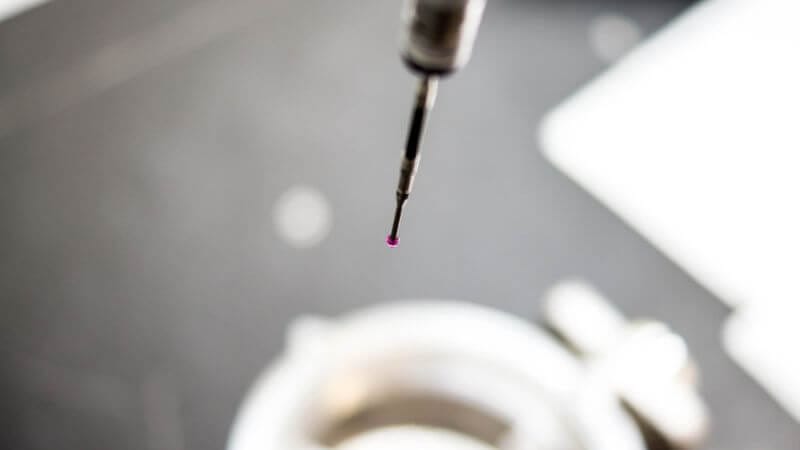
Visual inspection and dimensional checks confirm that castings meet geometric and surface requirements and will assemble correctly in service. Dimensional accuracy may be verified using Coordinate Measuring Machines (CMMs) and other precision inspection equipment.
Non-destructive testing
Where integrity is critical, non-destructive testing may be used to assess internal and surface-breaking defects. Depending on the application, this may include radiographic inspection, ultrasonic testing or dye penetrant testing. These methods are particularly relevant for components subjected to cyclic loading, pressure or corrosive environments.
Mechanical and material verification
Mechanical and material testing is used to verify that castings meet specified requirements for strength, hardness and chemical composition. This helps confirm that the part is not only dimensionally acceptable, but also capable of meeting its performance demands in service.
For buyers, inspection data should always be interpreted in context. Repeatable results over time are often a stronger indicator of supplier capability than isolated test outcomes. Equally important is how a supplier responds when problems occur. Structured root cause analysis and effective corrective action show that quality control is being used to strengthen the process, not simply manage exceptions.
For buyers, evaluating a supplier’s approach to quality control means looking beyond certificates alone. The strongest suppliers combine recognised standards with robust process discipline, clear traceability and transparent communication.
a) Certifications and approvals
Haworth Castings’ quality systems are underpinned by recognised certifications and sector approvals. The company is ISO 9001 certified and operates UKAS-approved testing, supporting customers in sectors such as defence, aerospace and energy. As a JOSCAR-registered supplier, Haworth Castings is also pre-qualified for Ministry of Defence programmes.
These accreditations matter, but buyers should also ask how quality is controlled in practice within day-to-day production.
b) Full documentation and traceability
Each casting should be supported by comprehensive quality records, including material certification, dimensional results and relevant test data. End-to-end traceability helps customers meet audit requirements and verify compliance throughout the production cycle.
For performance-critical applications, strong traceability is an important part of risk control as well as quality assurance.
c) Transparent communication and data exchange
For OEMs and Tier 1 suppliers working within demanding quality frameworks, clear and consistent data exchange is essential. Haworth Castings provides inspection records and quality documentation in customer-specified digital formats, supporting integration with FAIR, PPAP and other OEM quality systems.
This improves transparency, supports faster approvals and simplifies audit activity across multi-tier supply chains.
For performance-critical castings, quality control is not a one-off exercise. Consistent quality comes from stable processes, disciplined control and lessons carried forward from previous programmes.
For buyers, that level of process maturity is often what reduces technical and commercial risk most effectively. It lowers the likelihood of late-stage design changes, unexpected defects, rework or in-service failure. It also improves predictability around quality, lead times and long-term performance across the life of a programme.
By working with customers in this way, Haworth Castings combines disciplined quality control with practical casting expertise to help reduce delivery and performance risk in demanding applications. For organisations sourcing sand cast or gravity die cast metal components, an early, open conversation about quality control is often one of the most effective ways to build confidence and protect performance over the long term.
If you have a project, talk to our experienced sales team
Contact usAccess our library of aluminium sand casting photographs, video animations and articles.